How to play roulette from the first chip to the payout: the round step by step, inside and outside bets with payouts, table limits, etiquette, online vs live and mobile play.

Roulette Rules for Beginners: How to Play, Bets and Table Etiquette
The roulette rules fit in one sentence: you place chips on a number or a group of numbers, the dealer spins the wheel, and you win if the ball lands in a pocket your bet covers. Payouts are fixed in advance, from 35 to 1 on a single number to 1 to 1 on red or black, and the zero is what gives the casino its edge.
This guide walks through a round step by step, every inside and outside bet with its payout, table limits, etiquette at a live table, the difference between online and live games, and a checklist for your first session. If you want to practise as you read, open our free European roulette simulator in another tab.
Contents
- Roulette rules: how a round works
- The wheel and the table
- Inside bets and payouts
- Outside bets and payouts
- Table minimums and maximums
- Etiquette at a live table
- Online vs live roulette
- Playing roulette on mobile
- A first-session checklist
- Where RG2030 fits once you know the rules
Roulette rules: how a round works
Every round follows the same order, whether you sit at a casino table, watch a live dealer on your phone or play an RNG game.
- Get chips. At a land casino you place cash on the table and the dealer exchanges it for chips. Online, your balance is shown on screen and you pick a chip value.
- Place your bets. Put chips on the layout: on numbers (inside bets) or on the boxes around them (outside bets). You can place several bets in the same round.
- No more bets. The dealer spins the wheel one way and launches the ball the other way. When the ball starts to slow, the dealer calls “no more bets” (or “rien ne va plus”). Online, a timer closes the betting window.
- The ball lands. The pocket where it stops is the winning number.
- The dolly goes down. At a land table the dealer places a marker, the dolly, on the winning number. While it is there, nobody may place, collect or move bets.
- Payouts. Losing chips are swept away and winning bets are paid. Your original stake stays on the table with the winnings unless you pick it up.
- Next round. The dealer lifts the dolly and betting opens again.
The wheel and the table
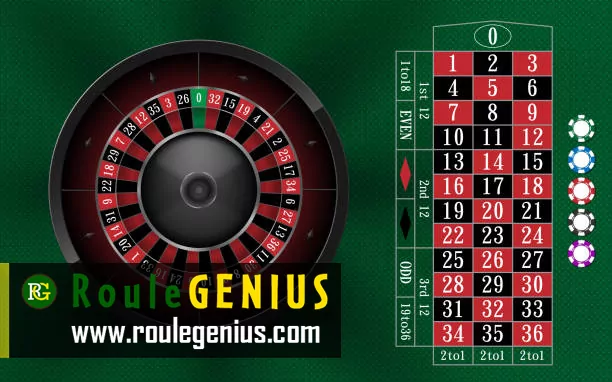
A European wheel has 37 pockets: the numbers 1 to 36, half red and half black, plus a green zero. An American wheel adds a second green pocket, the double zero, for 38 in total. French roulette uses the single-zero wheel with extra rules for even-money bets, explained below.
The betting layout puts the numbers 1 to 36 in a grid of three columns and twelve rows, with the zero (or zeros) at the top. The order on the layout is not the order on the wheel: on the wheel, numbers alternate red and black and are spread out on purpose. Our guide to the roulette wheel number order shows both, plus the racetrack used for sector bets.
If you have the choice, play a single-zero wheel. Every bet on a European wheel carries a 2.70% house edge, against 5.26% on an American wheel. The comparison is in European vs American vs French roulette.
Inside bets and payouts
Inside bets go on the numbers themselves. They cover few numbers and pay a lot.
| Bet | What it covers | Payout | Chance to win (European wheel) |
|---|---|---|---|
| Straight up | One number | 35 to 1 | 2.70% |
| Split | Two numbers next to each other on the layout | 17 to 1 | 5.41% |
| Street | Three numbers in a row | 11 to 1 | 8.11% |
| Corner | Four numbers in a square | 8 to 1 | 10.81% |
| First four (European) | 0, 1, 2 and 3 | 8 to 1 | 10.81% |
| Six line | Two rows, six numbers | 5 to 1 | 16.22% |
“35 to 1” means you receive 35 times your stake as winnings and keep the stake. A $10 straight-up bet that wins returns $360: $350 of winnings plus your $10.
On an American wheel there is one bet to avoid: the top line, covering 0, 00, 1, 2 and 3. It pays 6 to 1 and carries a house edge of 7.89%, the worst on the table. Every other American bet has an edge of 5.26%.
Outside bets and payouts
Outside bets sit around the grid and cover large groups of numbers. They win more often and pay less.
| Bet | What it covers | Payout | Chance to win (European wheel) |
|---|---|---|---|
| Red or black | 18 numbers of one colour | 1 to 1 | 48.65% |
| Odd or even | 18 odd or 18 even numbers | 1 to 1 | 48.65% |
| Low or high | 1 to 18 or 19 to 36 | 1 to 1 | 48.65% |
| Dozen | 1 to 12, 13 to 24 or 25 to 36 | 2 to 1 | 32.43% |
| Column | One of the three columns of 12 numbers | 2 to 1 | 32.43% |
The zero is not red or black, odd or even, low or high, and it is in no dozen or column. When it comes up, outside bets lose. That single pocket is why the chance of red is 48.65% and not 50%.
French tables soften this for even-money bets. With la partage, you lose only half of an even-money bet when zero comes up. With en prison, the bet stays on the table for the next spin: if it wins then, you get your stake back. Either rule cuts the house edge on even-money bets to about 1.35%.
All payouts, the odds of every bet and the “if I bet $100 on red” maths are collected in our roulette odds and payouts guide, and the roulette odds calculator works them out for any stake.
Table minimums and maximums
Every table has limits, shown on a sign at a land casino and in the game’s info panel online. There is usually a minimum and a maximum for inside bets and another pair for outside bets.
- Minimums. At many tables the inside minimum applies to the total of your inside bets in a round, so several small chips on different numbers can add up to it, while each outside bet must reach the outside minimum on its own. Read the sign or the rules screen before your first bet.
- Maximums. They cap how much you can put on one number or one outside box. They matter most to players who raise their stake after a loss: a doubling system hits the maximum after a short losing streak, as our Martingale strategy test shows.
- Online versus land. Online tables often accept much smaller stakes than a casino floor, which makes them a cheaper place to learn.
Etiquette at a live table
Etiquette is mostly about keeping the game clear for the dealer and fair for everyone.
- Wait for the right moment. Buy in or ask for change between rounds, not while the ball is spinning.
- Respect “no more bets”. After the call, do not place, move or remove chips. Late bets can be refused.
- Leave the dolly alone. Do not touch chips while the marker is on the table, and wait until every winner has been paid.
- Know your chips. Some casinos give each player chips of their own colour so bets cannot be confused. Coloured table chips are meant for that table only, so swap them back for regular casino chips before you leave.
- Keep your hands and belongings off the layout except to place or collect your own chips.
- Tipping is optional. Players who tip usually do it after a win, by handing chips to the dealer or placing a small bet for them.
Online live tables have their own manners. Keep the chat polite, remember that the dealer cannot influence the result, and place bets early: the betting window closes on a timer, and a slow connection can make you miss it.
Online vs live roulette
The roulette rules are the same everywhere. What changes is who spins the wheel and how fast the game runs.
- RNG roulette is software: a random number generator picks each result, and spins are instant. Licensed games are tested before release; in Great Britain, for example, the Gambling Commission says new games and random number generators can only go live once testing is complete and the report has been sent to it.
- Live dealer roulette streams a real wheel and a real dealer from a studio. It is slower, and you see the ball land. Variants such as Lightning, Immersive and Auto Roulette are explained in our live roulette games guide.
- Land-based roulette is the original: a physical table, chips you can touch and the slowest pace.
Pace matters more than most beginners think. A faster game means more spins per hour, and more spins means more money exposed to the house edge. Our roulette bankroll management guide shows the expected cost of an hour at different speeds.
Playing roulette on mobile
Most RNG and live roulette games run in a phone or tablet browser or in the casino’s app, with the same rules as on a computer. A few habits help on a small screen:
- Turn the phone sideways if the layout feels cramped, and take your time with chips on single numbers.
- Check your bets on the summary line before the timer runs out. A finger slip on a phone is easy to make.
- Play on a stable connection. If you lose the connection, the casino’s rules decide what happens to bets already placed, so read them once.
- Set deposit and time limits in your casino account settings before you start.
A first-session checklist
- Pick a single-zero (European or French) table.
- Read the table minimum and maximum.
- Decide a session budget you can afford to lose, and bring or deposit only that.
- Choose a small stake per spin, about 1% to 2.5% of the budget for even-money bets.
- Set a stop: a loss limit, a gain at which you leave, and a time limit.
- Practise the layout first on the free simulator.
- Know what each bet pays before you place it.
- Write down how long you played and the result. Leave when any of your limits is reached.
Where RG2030 fits once you know the rules
Once the rules are familiar, many players want to see what is actually happening at the table they play. RG2030, our roulette statistics web app, follows the numbers of your live table: on a phone or tablet you tap each result on the RG2030 table, and on a computer the optional RG2030 Bridge addon for Chrome reads them for you. After 500 numbers it shows what followed the last number on that table, starting with red or black, odd or even and low or high, and suggests a bet only when it has reached the Win Rate you set.
It does not change any rule or payout on this page, and no software can remove the house edge. It runs in the browser on any device, at $1 per minute from $50: see how RG2030 works.
Roulette is entertainment for adults (18+); if it stops being fun, our responsible gambling page lists where to get help.
Try RG2030, the latest RouleGENIUS
RG2030 collects the numbers of the live roulette you are playing and, after 500 numbers, shows statistics and suggestions built on that table, only when a bet reaches the Win Rate you choose. It runs in your browser on any device; the optional RG2030 Bridge addon for Chrome on a computer reads the numbers automatically and enables Autobet. You pay $1 per minute, with no subscription. It cannot promise wins: it gives you data to bet with more information.
Frequently asked questions
What are the basic rules of roulette?
Place chips on a number or group of numbers before the dealer calls “no more bets”. The ball lands in one pocket, losing bets are collected and winning bets are paid at fixed odds, from 35 to 1 on a single number to 1 to 1 on red or black.
Does roulette pay 35 or 36 to 1?
A single number pays 35 to 1. You also keep your stake, so a winning $1 bet returns $36 in total. A fair payout for one pocket in 37 would be 36 to 1, and that gap is the 2.70% house edge.
If I bet $100 on red, how much do I win?
If red comes up you win $100 and keep your $100 stake, so $200 comes back to you. If black or zero comes up, you lose the $100 (or $50 with la partage on a French table if it is zero).
What is the safest bet in roulette?
Even-money bets such as red, black, odd or even win most often, 48.65% of the time on a European wheel. On a French table with la partage they also have the lowest house edge, 1.35%. No bet is safe in the sense of avoiding the edge.
What happens to my bet if the ball lands on zero?
Outside bets lose, unless the table uses la partage (you get half back) or en prison (the bet stays for one more spin). Bets that include zero, such as a straight-up bet on 0 or the first four, are paid normally.
Is roulette 100% luck?
Each spin is decided by chance. What you control is the table you choose, how much you bet, how long you play and when you stop.