The exact order of the numbers on European and American roulette wheels, why it is mixed the way it is, and every sector bet on the racetrack with its chips and payouts.

Roulette Wheel Number Order, Sectors and the Racetrack
The roulette wheel number order on a European single-zero wheel, read clockwise from zero, is 0-32-15-19-4-21-2-25-17-34-6-27-13-36-11-30-8-23-10-5-24-16-33-1-20-14-31-9-22-18-29-7-28-12-35-3-26. The American double-zero wheel uses a different order, and both are arranged so that red and black alternate all the way round.
This guide shows both orders, explains why the numbers are mixed the way they are (we checked every pair of neighbors with a script), and lists the exact numbers, chips and payouts of the sector bets on the racetrack: Voisins du zéro, Tiers du cylindre, Orphelins, Jeu zéro and neighbor bets. It ends with a short history of the wheel.
Contents
- The European roulette wheel number order
- The American wheel order
- Why the numbers are not in order
- Sector bets: Voisins du zéro, Tiers, Orphelins and Jeu zéro
- Neighbor bets
- The racetrack
- A short history of the roulette wheel
- Using the wheel order when you play
The European roulette wheel number order
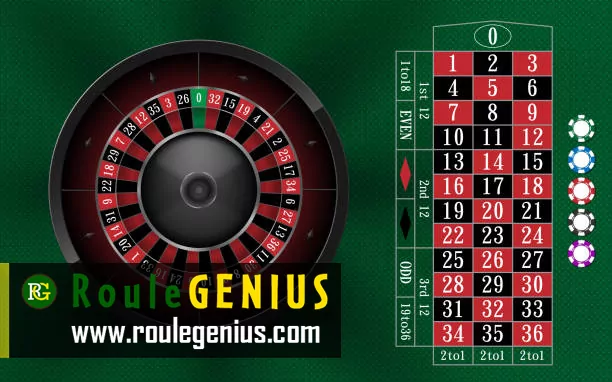
The single-zero wheel has 37 pockets: 0 in green and 1 to 36 in red and black. It is the wheel used for both European and French roulette, online and live. Clockwise from zero the pockets run:
0, 32, 15, 19, 4, 21, 2, 25, 17, 34, 6, 27, 13, 36, 11, 30, 8, 23, 10, 5, 24, 16, 33, 1, 20, 14, 31, 9, 22, 18, 29, 7, 28, 12, 35, 3, 26
- Voisins du zéro (17 numbers)
- Jeu zéro (7 numbers, inner arc)
- Tiers du cylindre (12 numbers)
- Orphelins (8 numbers)
The red numbers are 1, 3, 5, 7, 9, 12, 14, 16, 18, 19, 21, 23, 25, 27, 30, 32, 34 and 36; the other 18 are black. Two neighbors of zero are worth remembering because many sector bets start from them: 32 on the right and 26 on the left.
The American wheel order
The double-zero wheel has 38 pockets and a completely different sequence. Clockwise from zero:
0, 28, 9, 26, 30, 11, 7, 20, 32, 17, 5, 22, 34, 15, 3, 24, 36, 13, 1, 00, 27, 10, 25, 29, 12, 8, 19, 31, 18, 6, 21, 33, 16, 4, 23, 35, 14, 2
The American wheel is built in pairs. Zero and double zero sit exactly opposite each other, and every number faces its consecutive partner across the wheel: 1 opposite 2, 3 opposite 4, and so on up to 35 opposite 36. All 18 pairs follow this rule. Colors alternate here too. Because the order differs, the European sector bets below do not exist on a double-zero wheel; see European vs American vs French roulette for the other differences, starting with the 5.26% house edge.
Why the numbers are not in order
If the numbers ran 1, 2, 3 around the wheel, low numbers would sit on one side and high numbers on the other, and a small physical bias or a dealer’s habit could favor a whole outside bet. The real sequence spreads every outside bet evenly around the wheel. We checked the European order with a short script:
- Colors: all 35 pairs of neighboring numbers (zero aside) are one red and one black.
- Low and high: 34 of the 35 neighbor pairs mix a low number (1-18) with a high one (19-36). The only exception is 10 next to 5.
- Odd and even: mixed less strictly, 22 of 35 neighbor pairs.
- Any 9 pockets in a row (zero aside) hold 4 or 5 red numbers, 4 or 5 low numbers and 3 to 5 odd numbers.
- Balance: the 18 numbers on the right of zero (32 to 10) and the 18 on the left (5 to 26) both add up to 333. All the numbers on the wheel add up to 666.
On the American wheel colors alternate as well, but the paired layout puts many neighbors on the same side of 18: 16 of its 34 neighbor pairs are both low or both high. None of this changes the odds: on a fair wheel every pocket has the same 1 in 37 (or 1 in 38) chance, as our roulette odds and payouts guide explains.
Sector bets: Voisins du zéro, Tiers, Orphelins and Jeu zéro
Sector bets, also called call bets or announced bets, cover a whole arc of the wheel with a fixed set of chips on the layout. The three classic sectors split the single-zero wheel into three parts: Voisins du zéro (17 numbers), Tiers du cylindre (12) and Orphelins (8), which together cover all 37 pockets. Jeu zéro is a smaller arc of 7 numbers inside Voisins.
| Bet | Numbers, in wheel order | Chips | Where the chips go |
|---|---|---|---|
| Voisins du zéro | 22, 18, 29, 7, 28, 12, 35, 3, 26, 0, 32, 15, 19, 4, 21, 2, 25 | 9 | 2 on the 0/2/3 trio, 2 on the 25/26/28/29 corner, 1 on each split 4/7, 12/15, 18/21, 19/22, 32/35 |
| Jeu zéro | 12, 35, 3, 26, 0, 32, 15 | 4 | 1 on each split 0/3, 12/15, 32/35 and 1 straight up on 26 |
| Tiers du cylindre | 27, 13, 36, 11, 30, 8, 23, 10, 5, 24, 16, 33 | 6 | 1 on each split 5/8, 10/11, 13/16, 23/24, 27/30, 33/36 |
| Orphelins | 17, 34, 6 and 1, 20, 14, 31, 9 | 5 | 1 straight up on 1, 1 on each split 6/9, 14/17, 17/20, 31/34 |
Because the chips sit on splits, corners and a trio, the win depends on which number comes up. These are the net results in chips, after paying for the whole bet:
| Bet | Chance of a hit | Net win when it hits | House edge |
|---|---|---|---|
| Voisins du zéro (9 chips) | 17 in 37, 45.95% | +15 on 0, 2, 3; +9 on the other 14 numbers | 2.70% |
| Jeu zéro (4 chips) | 7 in 37, 18.92% | +32 on 26; +14 on 0, 3, 12, 15, 32, 35 | 2.70% |
| Tiers du cylindre (6 chips) | 12 in 37, 32.43% | +12 on any of its numbers | 2.70% |
| Orphelins (5 chips) | 8 in 37, 21.62% | +31 on 1 and 17; +13 on 6, 9, 14, 20, 31, 34 | 2.70% |
A worked example with $1 chips: Voisins du zéro costs $9. If the ball lands on 26, the two chips on the 25/26/28/29 corner pay 8 to 1, so you collect $18 and are $9 up. On 0 the two chips on the trio pay 11 to 1: $24 back, $15 up. On 10, which lies in Tiers, you lose the $9.
Two variants are common. “Tiers 5-8-10-11” adds a straight-up chip on 5, 8, 10 and 11 for a 10-chip bet, and “zero spiel naca” adds a straight-up on 19 to Jeu zéro for 5 chips. The house edge stays 2.70%: sector bets are a quick way to cover part of the wheel, and the odds of every pocket stay the same.
Neighbor bets
A neighbor bet covers one number plus the numbers next to it on the wheel, with one chip straight up on each. The standard version is a number and two neighbors on each side, 5 chips. “17 and the neighbors” covers 2, 25, 17, 34 and 6; “0 and the neighbors” covers 3, 26, 0, 32 and 15.
| Neighbors each side | Numbers and chips | Chance of a hit | Net win when one hits |
|---|---|---|---|
| 1 | 3 | 8.11% | +33 chips |
| 2 | 5 | 13.51% | +31 chips |
| 3 | 7 | 18.92% | +29 chips |
| 4 | 9 | 24.32% | +27 chips |
The racetrack
The racetrack is the oval area printed next to the betting grid at many single-zero tables. It shows the numbers in wheel order, not in layout order, with the sectors marked on it. Instead of placing nine separate chips for Voisins du zéro, you click the Voisins area once; instead of finding five scattered numbers for a neighbor bet, you click one number on the track and the game places the chips around it.
Online and at live tables the software places the chips for you. At a land-based table you hand the chips to the dealer and announce the bet. Either way it is the same set of ordinary inside bets, so the payout table and the 2.70% edge do not change.
A short history of the roulette wheel
“Roulette” means “little wheel” in French. Many historians credit Blaise Pascal with a primitive form of the wheel in the 17th century, while the game in something close to its modern form was described in Paris: the novel La Roulette, ou le Jour by Jaques Lablee, published in 1801, describes a roulette wheel in the Palais Royal in 1796.
The decisive change came in 1843, when the French brothers François and Louis Blanc introduced the single-zero wheel at Bad Homburg, in Germany. When legal gambling ended there in the 1860s, the Blanc family moved to Monte Carlo, where the single-zero game became the main attraction.
In the United States the French double-zero wheel traveled up the Mississippi from New Orleans and stayed. Today the double zero is the American standard, and some casinos even use a triple zero, with a 7.69% edge on a straight-up bet.
Using the wheel order when you play
Knowing the order helps you read a table: the racetrack, the statistics panels some live games display, and any tracker that groups results by wheel position. Practice the racetrack bets for free in our European roulette simulator, and log a real table’s results with the free roulette number tracker.
For single numbers at a live table, RG2030 adds the AI Analyzer from the Premium Pack and the VIP Wheel Tracker Analyzer, its most advanced single-number engine, from the VIP Pack. Its statistics are built on the 500 or more numbers collected from the table you play, at $1 per minute from $50 (see pricing). They describe your table; they do not change the odds of any pocket.
Try RG2030, the latest RouleGENIUS
RG2030 collects the numbers of the live roulette you are playing and, after 500 numbers, shows statistics and suggestions built on that table, only when a bet reaches the Win Rate you choose. It runs in your browser on any device; the optional RG2030 Bridge addon for Chrome on a computer reads the numbers automatically and enables Autobet. You pay $1 per minute, with no subscription. It cannot promise wins: it gives you data to bet with more information.
Frequently asked questions
What is the order of numbers on a roulette wheel?
On a European wheel, clockwise from zero: 0, 32, 15, 19, 4, 21, 2, 25, 17, 34, 6, 27, 13, 36, 11, 30, 8, 23, 10, 5, 24, 16, 33, 1, 20, 14, 31, 9, 22, 18, 29, 7, 28, 12, 35, 3, 26. The American wheel starts 0, 28, 9, 26 and has the 00 between 1 and 27.
Why are roulette numbers not in order?
So that red and black, low and high, and odd and even are spread evenly around the wheel. On the European wheel red and black alternate in every pair of neighbors, and low and high alternate in all pairs but one (10 and 5).
What numbers are in Voisins du zéro?
The 17 numbers from 22 to 25 around zero: 22, 18, 29, 7, 28, 12, 35, 3, 26, 0, 32, 15, 19, 4, 21, 2 and 25. The bet uses 9 chips and wins +9 or +15 chips when it hits.
What are the Orphelins numbers?
The 8 numbers not covered by Voisins or Tiers: 17, 34, 6 on one side of the wheel and 1, 20, 14, 31, 9 on the other. The bet uses 5 chips: one on 1 and one on each split 6/9, 14/17, 17/20 and 31/34.
Do the numbers on a roulette wheel add up to 666?
Yes. 0 + 1 + 2 + … + 36 = 666, and on the European wheel the 18 numbers on each side of zero add up to 333. It is a curiosity of the numbering and has no effect on the game.
Roulette is a game of chance for adults only (18+). Set a budget before you play and read our responsible gambling page if it stops being fun.